VALORANT Champions Shanghai Group Stage Explained
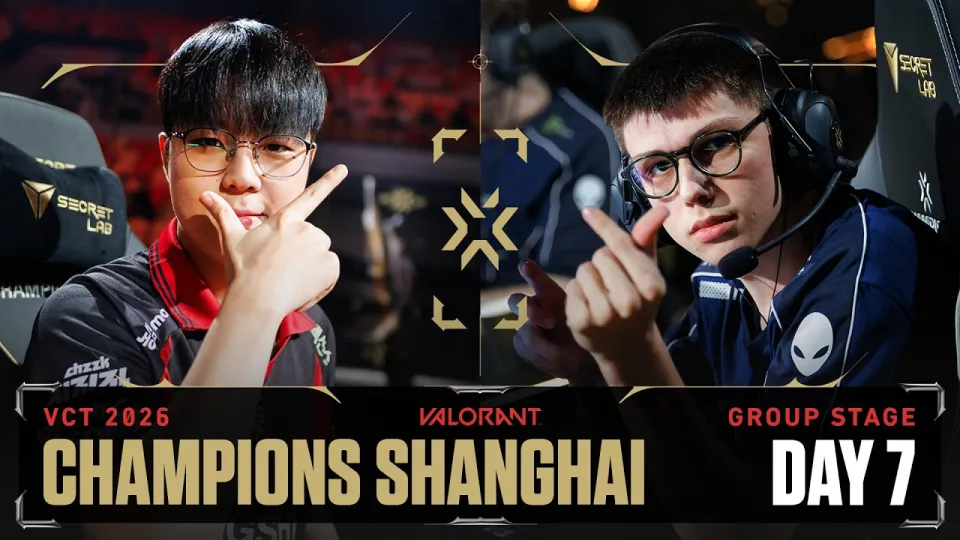
Video: VALORANT Champions Shanghai — Group Stage — Day 7
Need articles like this for your video? They help promote it on YouTube and Google — order them in the Telegram bot @sat_sit_bot. Articles with your video embedded are written and posted by the bot itself — on popular topical sites (no ads). Try it free: 50 articles on us.
VALORANT Champions Shanghai is the 2026 world championship where 16 teams from the Americas, CN, EMEA and Pacific play through a group stage from September 24 to October 18 for the year's biggest trophy. Day 7 of that group stage, published by the VALORANT Champions Tour on October 1, is the broadcast that shows the tournament's central story: familiar giants, new contenders and a fearless generation of challengers sharing one stage.
For live brackets, schedule changes and match-day announcements, the official feed at VALORANT Esports on X is the fastest source; it is the channel the broadcast itself points viewers toward.
What the VALORANT Champions Shanghai format actually is
The format is a 16-team group stage that funnels four regions into a single bracket, and it exists to separate teams that can adapt from teams that only execute prepared setups. Shanghai is the season's final checkpoint, so every group match carries seeding weight rather than just pride.
- Sixteen qualified teams are split across four regional pools: Americas, CN, EMEA and Pacific.
- Group play runs inside the September 24 – October 18 window, with multiple matches per broadcast day.
- Only the strongest records advance, which is why a single lost eco round can decide a tiebreaker.
- The survivor of the bracket is crowned the 2026 VALORANT World Champion.
The broadcast description frames the event around a shift in the competitive order: two Masters events in 2026 produced two different champions, and Shanghai is where those results get reconciled. That context matters when reading group-stage results, because a team that peaked in a Masters split is not automatically the favorite in a longer, more punishing format.
Day 7 on the broadcast: tech pauses and split-second reads
Day 7 is remembered less for a single highlight than for its rhythm, which was repeatedly interrupted. Viewers in the comments counted an "endless series of tech pauses," and one of the most-liked posts in the thread was a spoiler-blocking timestamp list that had to be edited because of a pause. For anyone watching the VOD after the fact, that is practical information: the broadcast is long, and the pauses shift every timestamp that follows them.
There were genuine moments too. One comment flagged a Split round where a Yoru clone briefly looked like it was helping hold a site, a reminder of how convincingly VALORANT utility can fake presence. Another viewer singled out nats as the player of the day. The mix is typical of a group-stage broadcast: long technical gaps, then sudden rounds that decide a map.
Why CN teams became the group stage's flashpoint
The most heated discussion around Day 7 concerned the CN representatives, and the criticism was specific rather than general. Viewers pointed to unlosable rounds dropped against eco buys, lost 5v2 retakes and utility usage that looked improvised once prepared strategies broke down. The harshest take in the thread argued that China deserved to lose at that point, while a smaller counter-current insisted the region still has merit and that other regions left stronger teams at home.
That second argument is worth taking seriously. A 16-team field is a compression of four regions, and qualification paths differ in depth. When a CN seed exits early, the fair question is not whether the region is weak but whether the slot allocation reflects the actual strength of the pool. Group stage upsets amplify that debate because the sample is tiny: two bad maps can end a run.
How to watch the group stage without spoilers
Watching a multi-hour VOD after the fact requires a plan, and the Day 7 thread shows why. The most useful approach:
- Open the VOD on the VALORANT Champions Tour channel and avoid the recommended sidebar, which leaks results through thumbnails and titles.
- Use a timestamp list built by another viewer, but expect it to drift after any technical pause.
- Watch map by map rather than in one sitting; group-stage days routinely run past the five-hour mark, and Day 7 included a moment referenced near the 5:08:08 mark.
- Keep the official X account closed until you finish, since live posts confirm winners within minutes.
Reading group-stage results like a coach
Group-stage scorelines in VALORANT are noisy, and the way to extract signal is to separate round types. A team that wins pistol rounds and converts them is executing fundamentals. A team that loses to eco buys is leaking economy discipline, which compounds across a series. A team that wins 5v2 retakes is showing communication under pressure, the trait that survives into playoffs.
The Day 7 commentary effectively applied this lens to CN sides: the complaint was not about aim but about creativity once set plays failed. That is the same failure mode that has decided past international group stages, and it is why analysts weight adaptation over raw firepower when projecting playoff runs.
Useful links
- Official VALORANT Esports news and schedule: https://www.valorantesports.com/news
- Event hub: https://www.valorantesports.com
- Live updates on X: https://x.com/valorantesports
- Facebook: https://www.facebook.com/ValorantEsports/
- Instagram: https://www.instagram.com/valorantesports/
- TikTok: https://www.tiktok.com/@valorantesports
- Twitch: https://www.twitch.tv/valorant
- Event photos: https://www.flickr.com/photos/valorantesports/
What Shanghai sets up for the rest of the season
Shanghai is the point where the 2026 season stops being a series of regional stories and becomes one verdict. Two Masters titles split between different champions means no team arrives with undisputed authority, and a group stage that punishes slow adaptation will expose anyone relying on reputation. The Day 7 broadcast, with its pauses and its upsets, is a useful snapshot of that pressure: technical interruptions, contested regions and rounds decided by a single read. The VALORANT Champions Tour produced the full Day 7 coverage, and following the official VALORANT Esports account on X is the simplest way to catch bracket updates, schedule changes and the next broadcast window before the October 18 final.
Key takeaways
- 16 teams from Americas, CN, EMEA and Pacific compete for the 2026 VALORANT world title in Shanghai.
- The event runs from September 24 to October 18, with Day 7 of the group stage broadcast on October 1.
- Two different Masters champions in 2026 set up Shanghai as the tiebreaker of the season.
- Day 7 drew viewer complaints about repeated technical pauses and about CN teams losing winnable rounds.
- Full VOD coverage airs on the VALORANT Champions Tour channel, with live updates via @valorantesports.
Source: VALORANT Champions Shanghai — Group Stage — Day 7 · Markdown version
Questions & answers
How many teams play in the VALORANT Champions Shanghai group stage?
Sixteen teams qualify, drawn from four regions: Americas, CN, EMEA and Pacific. They compete inside a group stage that runs from September 24 to October 18, and the surviving team becomes the 2026 VALORANT World Champion.
Why did Day 7 of the group stage have so many technical pauses?
The broadcast was interrupted repeatedly by tech pauses, which viewers noted in large numbers. The pauses also broke the timestamp lists fans build for spoiler-free viewing, since every later round shifts position in the VOD.
Are CN teams really the weakest region at Champions?
That claim came up in viewer discussion after costly losses to eco buys and failed 5v2 retakes, but the counterargument is about slot depth: other regions may have left stronger teams at home. A 16-team field is a small sample, so early exits say as much about format as about regional strength.
Where can I follow the rest of the tournament?
Official updates, brackets and schedule changes are posted on the VALORANT Esports X account at https://x.com/valorantesports, and full match VODs appear on the VALORANT Champions Tour channel. The event hub at valorantesports.com carries news and additional information.